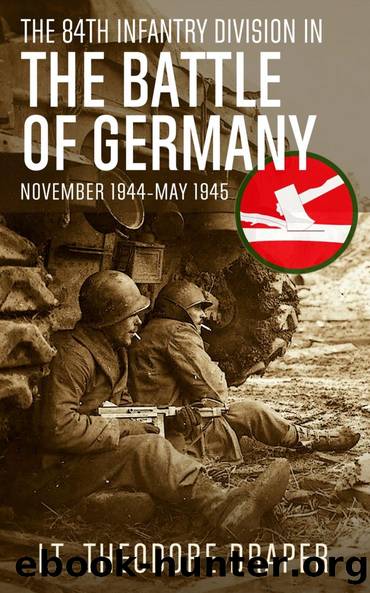
The 84th Infantry Division in The Battle of Germany by Lt. Theodore Draper
Author:Lt. Theodore Draper [Draper, Lt. Theodore]
Language: eng
Format: epub
Tags: History, Military, United States, Europe, General, Germany, Special Forces
ISBN: 9781839741258
Google: KvnCDwAAQBAJ
Publisher: Pickle Partners Publishing
Published: 2019-12-06T03:06:35+00:00
THE ENGINEERS. In addition to our own 309th Engineer (C) Battalion, the 171st Engineer (C) Battalion was placed in direct support of the 84th Infantry Division for the Roer crossing. In general, the 309th was responsible for the assault boat crossing and the 171st for the bridges.
The crossing was planned on a one-battalion front, that is, one battalion would cross at a time. The first battalion would cross in assault boats in two waves, two companies and 35 boats in each wave. The first two waves would be provided with their own boats so that no re-crossing of the river would be necessary to bring over the entire first battalion. In the event the footbridges were not available in time, provisions were made to cross succeeding infantry battalions in assault boats, too.
The assault boat crossing was assigned to Company B and two platoons of Company A, 309th Engineers. They were responsible for operating the boats and furnishing engineer guides to the crossing sites. If footbridges were in, the engineer guides would lead the next battalion to cross to the bridge sites. If not, the engineer crewmen would cross the second battalion in assault boats. After the first two battalions were crossed in boats or on bridges, four engineer boat crews would remain near the crossing sites to evacuate casualties. Company C, 309th Engineers, was placed in general support of the operation in Geilenkirchen on a 15-minute alert from H-Hour.
A detailed study was made of road blocks and other obstacles on the east side of the Roer. Most of this information came from patrols, prisoners, and aerial reconnaissance. It was planned to cross an engineer platoon in assault boats or on the footbridge if available and to send special equipment over on LVTs (Landing Vehicles Tracked). This special equipment included an R4 tractor, 12 sections of prefabricated wooden treadway bridge on wheels, a jeep, and a ¼-ton trailer. It was believed that this platoon and equipment could neutralize all blocks encountered prior to the crossing of additional engineer platoons and equipment on heavier bridges. As soon as the vehicle bridges were open, Company C, 309th Engineers, was to work on all east-bank obstacles.
Three infantry footbridges were planned across the Roer at Linnich, approximately 200 yards between the first two and 100 yards between the last two. On D-minus-2, the equipment for these bridges was to be taken to a storage site about 150 yards from the river. At H-minus-3M Hours, this equipment was to be carried by hand to the bridge sites and placed along the bank, but clear of the assault boat paths in the vicinity. The anchor and float cables were to be carried across in the initial wave at H-Hour and construction of the footbridges started immediately. The estimated completion time for the first footbridge was H-plus-45 minutes. A 1-inch rope was also to be taken across for lifesaving purposes. These bridges were assigned to Company A, 171st Engineers.
An infantry support bridge to support a 2-1/2-ton truck was planned at bridge site No.
Download
This site does not store any files on its server. We only index and link to content provided by other sites. Please contact the content providers to delete copyright contents if any and email us, we'll remove relevant links or contents immediately.
Personalized inhaled bacteriophage therapy for treatment of multidrug-resistant Pseudomonas aeruginosa in cystic fibrosis by unknow(175611)
CONSORT 2025 statement: updated guideline for reporting randomized trials by unknow(84042)
Critical evaluation of the ProfiLER-02 study design and outcomes by Vivek Subbiah & Razelle Kurzrock(83703)
Cardiac gene therapy makes a comeback by Oliver J. Müller & Susanne Hille & Anca Kliesow Remes(83506)
Whisky: Malt Whiskies of Scotland (Collins Little Books) by dominic roskrow(74438)
Unveiling the design rules for tunable emission in graphene quantum dots: A high-throughput TDDFT and machine learning perspective by Şener Özönder & Mustafa Coşkun Özdemir & Caner Ünlü(50893)
A yeast-based oral therapeutic delivers immune checkpoint inhibitors to reduce intestinal tumor burden by unknow(40260)
Covalent hitchhikers guide proteins to the nucleus by Alexander F. Russell & Madeline F. Currie & Champak Chatterjee(40216)
Meet the Authors: Christopher R. Mansfield and Emily R. Derbyshire by Christopher R. Mansfield & Emily R. Derbyshire(40096)
Alkaline-earth metals promote propane dehydrogenation with carbon dioxide through geometric effects: Altering the reaction pathway by unknow(32731)
Induced iron vacancies boosting FeOOH loaded on sustainable Fenton-like collagen fiber membrane for efficient removal of emerging contaminants by unknow(32507)
Efficient electric-field-assisted photochemical conversion of methane to n-propanol exclusively over penetrated TiO2Ti hollow fibers by Guanghui Feng(32453)
Bi2SiO5 nanosheets as piezo-photocatalyst for efficient degradation of 2,4-Dichlorophenol by Hangyu Shi & Yifu Li & Lishan Zhang & Guoguan Liu & Qian Zhang & Xuan Ru & Shan Zhong(32387)
A novel NDIPTA organic heterojunction photocatalyst with built-in electric field for efficient hydrogen production by Jiahui Yang & Baojun Ma & Yongfa Zhu(32361)
Enhanced conversion of methane to liquid-phase oxygenates via hollow ferrite nanotube@horseradish peroxidase based photoenzymatic catalysis by Jun Duan & Shiying Fan & Xinyong Li & Shaomin Liu(32333)
Ordered macroporous superstructure of defective carbon adorned with tiny cobalt sulfide for selective electrocatalytic hydrogenation of cinnamaldehyde by Xiao-Shi Yuan & Sheng-Hua Zhou & San-Mei Wang & Wenbo Wei & Xiaofang Li & Xin-Tao Wu & Qi-Long Zhu(32257)
What's Done in Darkness by Kayla Perrin(27148)
Topological analysis of non-conjugated ethylene oxide cored dendrimers decorated with tetraphenylethylene: Insights from degree-based descriptors using the polynomial approach by A Theertha Nair & D Antony Xavier & Annmaria Baby & S Akhila(26523)
Investigation of mechanical and self-healing properties of hydroxyl-terminated polybutadiene functionalized with 2-ureido-4-pyrimidinone by Mohsen Kazazi & Mehran Hayaty & Ali Mousaviazar(26458)
